EN
EN  IT
IT  SQ
SQ  ES
ES  FR
FR 
Being told that you do not have enough bone for dental implants can feel like the end of the road. In fact, severe bone loss does not always mean that fixed teeth are impossible.
For some patients with severe bone loss in the upper jaw, zygomatic implants may offer an alternative when conventional implants cannot achieve sufficient support.
At Family Dental Care in Tirana, complex implant cases are assessed individually to determine the most suitable solution.
Why Does Bone Loss Complicate Dental Implant Treatment?
Traditional implants are placed in the jawbone and require sufficient bone volume to achieve stability.
However, after tooth loss, the bone tends to gradually resorb. This problem may be more pronounced in patients who lost their teeth many years ago or who have worn removable dentures for a long time.
Other possible causes include:
- advanced periodontal disease;
- previous dental infections;
- failure of existing implants;
- previous unsuccessful bone regeneration procedures;
- trauma or surgery.
In the upper jaw, the presence of the maxillary sinus can make some cases even more complex.
Does Insufficient Bone Mean You Cannot Have Dental Implants?
Not necessarily.
Bone loss is not always uniform throughout the jaw. A patient may have very little bone in one area while retaining a usable amount in another.
Before considering zygomatic implants, the following solutions may be evaluated:
- conventional implants;
- tilted implants;
- short implants;
- bone regeneration;
- maxillary sinus procedures;
- All-on-4 or All-on-6.
Zygomatic implants are generally reserved for more advanced cases.
What Are Zygomatic Implants?
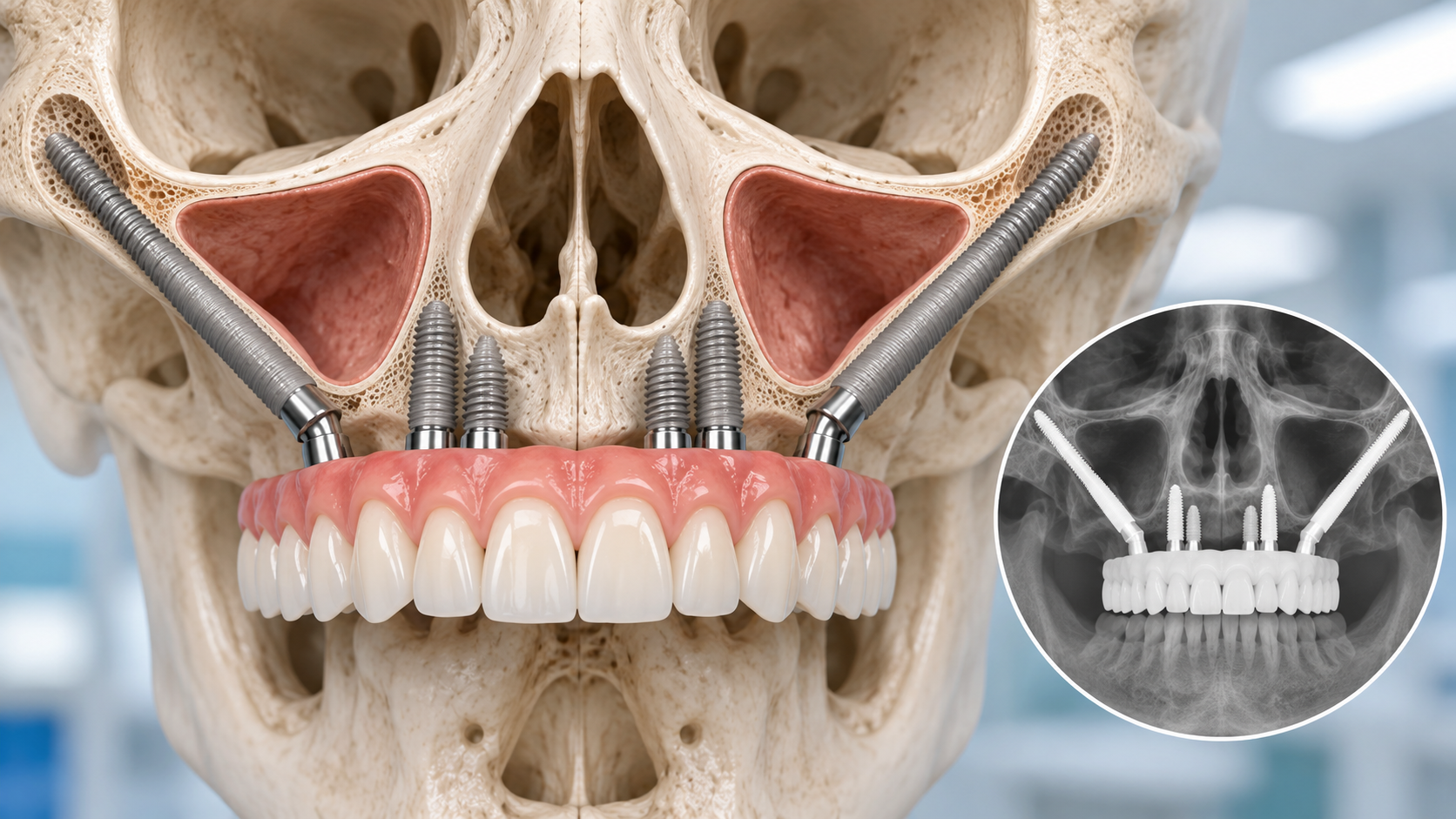
Zygomatic implants are longer than traditional dental implants.
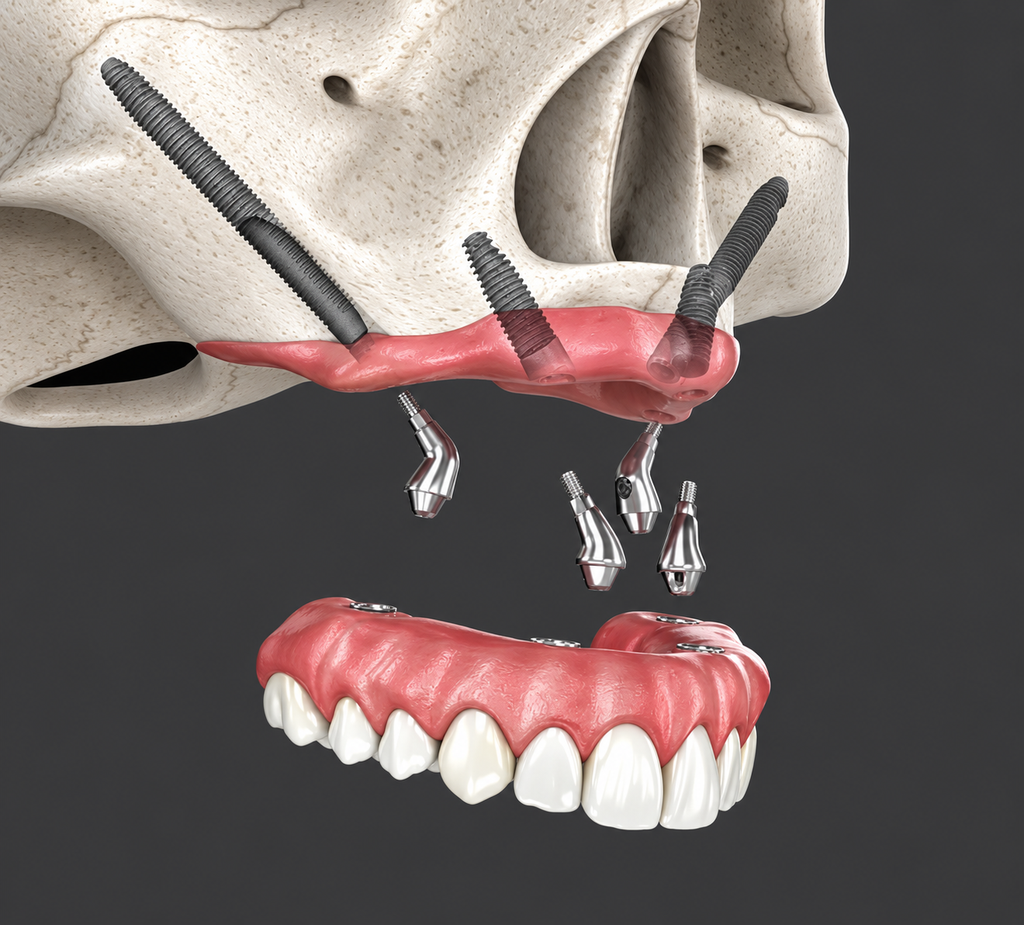
Rather than relying primarily on the bone of the upper jaw, they are anchored in the zygomatic bone, also known as the cheekbone. This area is particularly dense and can provide stable support even when the upper jaw has undergone significant bone resorption.
They are not simply longer conventional implants. They are designed for complex upper-jaw rehabilitation and require specialized surgical planning.
Who May Be a Candidate?
Zygomatic implants may be considered primarily for patients with severe upper-jaw atrophy.
Severe Bone Loss in the Upper Jaw
When there is not enough jawbone remaining to safely support conventional implants, the zygomatic bone can provide an alternative anchorage point.
Failed Bone Grafting
Some patients have already undergone bone reconstruction procedures without achieving sufficient support. In these cases, zygomatic implants may offer another option.
Failure of Previous Implants
The loss of previous implants can further reduce the amount of available bone. The new treatment plan must therefore assess whether another conventional approach is still possible.
When Extensive Bone Grafting Is Best Avoided
In some advanced cases, the alternative would be extensive bone regeneration followed by a healing period before the implants are placed.
For selected patients, zygomatic implants may make it possible to avoid this process. However, the choice always depends on the patient’s anatomy, general health, and surgical assessment.
Are Zygomatic Implants Only Used in the Upper Jaw?
Sì.
Zygomatic implants are designed for cases of severe bone loss in the upper jaw.
They are not used to treat bone deficiency in the lower jaw. Patients with bone loss in the lower dental arch require different strategies based on the remaining bone and surrounding anatomical structures.
Zygomatic Implants vs. Bone Grafting
Both solutions can enable the rehabilitation of patients with severe bone loss, but they work differently. With bone regeneration, the aim is to rebuild the lost bone volume and subsequently place conventional implants.
Zygomatic implants, on the other hand, use the cheekbone as an anchoring structure.
There is no single solution that is best for everyone. The choice depends on:
- the amount and location of the remaining bone;
- the anatomy of the maxillary sinus;
- previous treatments;
- the condition of the remaining teeth;
- general health;
- the type of rehabilitation desired.
At Family Dental Care, the technique is selected based on each individual case, not simply because it is more advanced.
All-on-4 or Zygomatic Implants?
Many patients with bone loss can still be treated with All-on-4. This technique uses strategic implant placement, including tilted posterior implants, to make the best use of the available bone.
However, when bone resorption in the upper jaw is too advanced, even this approach may not provide sufficient support. In these cases, zygomatic implants may be one of the options considered.
How Many Zygomatic Implants Are Needed?
The number required depends on the patient’s anatomy and the amount of bone still available.
In some patients, zygomatic implants can be combined with conventional implants. In more advanced cases, a configuration using multiple zygomatic implants may be used.
One example is Quad Zygoma, which uses four zygomatic implants, two on each side. The configuration must be determined following detailed diagnostic examinations and comprehensive prosthetic planning.
Why Is a 3D CT Scan Essential?
Zygomatic implants require much more extensive planning than conventional implant dentistry.
A 3D CT scan allows the surgeon to assess:
- the remaining jawbone;
- the zygomatic bone;
- the maxillary sinuses;
- the surrounding anatomical structures;
- the implant trajectories;
- the position of the future fixed teeth.
Family Dental Care uses panoramic X-rays and 3D CT scans when assessing complex dental implant cases.
Is the Procedure More Complex?
Sì.
The placement of zygomatic implants is an advanced surgical technique. The length of the implants and the anatomy involved make the treatment more complex than conventional implant dentistry.
As with any surgical procedure, complications may occur, including maxillary sinus issues, infections, soft-tissue problems or difficulties with implant integration.
For this reason, diagnostics, patient selection, planning and surgical expertise are essential.
Have You Already Been Told That You Cannot Have Dental Implants?
A previous assessment indicating that you have insufficient bone is important, but it does not necessarily mean that there are no other options. A new assessment may show that conventional implants, All-on-4, bone regeneration or other techniques are still possible.
In cases involving more severe bone loss in the upper jaw, zygomatic implants may offer an additional option. The answer must always be based on a comprehensive diagnosis, not an assumption.
Send Your X-Ray to Family Dental Care 📲🦷
Have you been told that you have too little bone for dental implants?
Before assuming that removable dentures are your only option, request an evaluation at Family Dental Care in Tirana. The team can assess whether your case is better suited to conventional implants, All-on-4, bone regeneration, or zygomatic implants.
To get started:
- send a panoramic X-ray or a previous CT scan;
- 📸 send clear photos of your teeth and smile;
- 🦷 provide details of any previous implants or treatments;
- 📲 request an initial personalized assessment;
- 🇮🇹 plan your treatment journey with the team if you are traveling from Italy.
WhatsApp: +355 69 70 433 35
Email: info@familydentalcareal.com
📍 Family Dental Care – Tirana, Albania
Severe bone loss makes treatment more complex, but it does not always mean giving up on fixed teeth. Find out which solutions may be genuinely suitable for your case.