EN
EN  IT
IT  SQ
SQ  ES
ES  FR
FR 

A complex dental problem rarely involves just one tooth.
It can simultaneously involve missing teeth, infections, gums, bone loss, old prosthetics, and bite issues.
That is why choosing a dental clinic for complex treatments means, above all, looking for a team capable of connecting all these elements into a single treatment plan.
Family Dental Care brings together different dental specialties and offers coordinated treatment pathways for implantology, prosthetics, periodontics, endodontics, and other dental needs.
When Does a Dental Case Become Complex?
There is no definition based simply on the number of teeth to be treated.
A case can become complex when multiple problems are present and affect one another.
For example:
- several missing teeth;
- teeth with an uncertain prognosis;
- previous implants that need to be assessed;
- old crowns or bridges;
- infections;
- bone loss;
- periodontal disease;
- aesthetic issues associated with functional problems;
- the need to reconstruct an entire dental arch.
In these cases, treating one problem without considering the others can lead to an incomplete treatment plan.
The First Goal Is Not to Treat. It Is to Understand.
When a patient presents with multiple dental problems, it can be easy to focus immediately on the most obvious one.
- A broken tooth.
- A removable prosthesis.
- A gap where teeth are missing.
- An old crown.
But what the patient sees does not always represent the main problem.
Before deciding on any procedure, it is necessary to understand how the teeth, gums, bone, and occlusion work together.
That is why a comprehensive evaluation comes before selecting the treatment.
One Plan for the Entire Mouth
Let us imagine a patient with two missing teeth, an infected molar, an old crown, and gum inflammation. They may need multiple treatments as part of the same course of care.
Implantology, endodontics, periodontology, and prosthodontics must be coordinated with one another. Each specialist must know the full treatment plan before intervening.
The goal is to avoid separate treatments and build a solution that takes the entire mouth into account. This is particularly important in complex dental cases.
The Advantage of a Multidisciplinary Team
Family Dental Care has a team of professionals with different clinical expertise, including maxillofacial surgery, prosthodontics, oral and periodontal surgery, orthodontics, and endodontics.
This type of structure becomes especially useful when the case cannot be resolved by a single specialty.
Surgery and Implantology
They manage the surgical aspect of treatment and implant planning.
Prosthodontics
It turns the dental or implant structure into a functional restoration.
Periodontics
It evaluates the health of the tissues surrounding teeth and implants.
Endodontics
It can make it possible to preserve teeth that require internal treatment before reconstruction. Each specialty addresses one part of the problem. The complete plan, however, must resolve the case as a whole.
Saving a Tooth or Replacing It?
This is one of the most important decisions in complex cases. Not all compromised teeth need to be extracted. At the same time, not all teeth can be preserved reliably.
The decision should take into account:
- the amount of remaining tooth structure;
- the condition of the root;
- bone support;
- gum health;
- any infections;
- tooth position;
- the role of the tooth in the future rehabilitation.
Only after this evaluation can it be decided whether to proceed with conservative treatment, a crown, extraction, or an implant.
When Multiple Implants Are Needed
Extensive tooth loss requires a completely different strategy than a single implant.
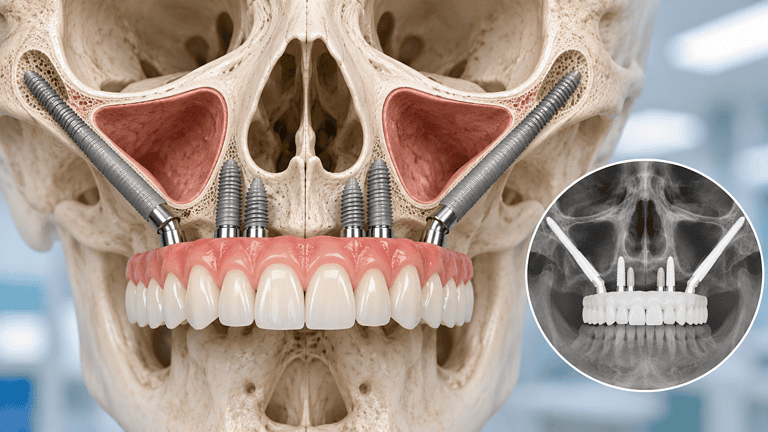
Family Dental Care offers solutions such as All-on-4, All-on-6, and All-on-8, in addition to standard implantology.
The choice between these options depends on the patient’s anatomy and the future prosthesis. It is not determined simply by whether more or fewer implants are used.
- All-on-4: It can allow for a full rehabilitation using four strategically placed implants.
- All-on-6: It adds additional support points when indicated by the treatment plan.
- All-on-8: It may be considered when eight implants can be distributed along the arch and the clinical plan benefits from it.
What Happens When There Is Not Enough Bone
Bone loss can occur after years without teeth, in the presence of periodontal disease, or after previous infections. However, this does not automatically mean that implants are not possible.
Before deciding on treatment, it is necessary to assess the quantity and quality of the available bone. In some cases, a bone regeneration procedure may be indicated.
Family Dental Care integrates this type of treatment into implant planning when necessary. The choice is made after diagnostic tests and a careful surgical evaluation.
Gums Are Also Part of the Final Result
Gum health is important for both natural teeth and implants. For this reason, in complex cases, the focus should not be only on the teeth.
If periodontal disease is present, it must be assessed and managed during the course of treatment. Good gum health helps create a more stable foundation for the future restoration.
Function Before Aesthetics
Many patients come to the clinic because they want to improve the appearance of their smile. In complex treatments, however, aesthetics must be accompanied by proper function.
Before planning the final outcome, it is necessary to evaluate:
- how the dental arches come together;
- where the forces are distributed;
- which teeth can be preserved;
- how the future prosthesis will be supported;
- whether the patient is able to maintain proper oral hygiene.
These factors help create a more comprehensive rehabilitation. The final outcome must combine aesthetics, stability, and function.
Diagnostics Reduce Decisions Based on Assumptions
In complex cases, a simple look inside the mouth is not enough. The examination must be combined with the necessary radiographic tests and an overall assessment of the situation.
For implantology in particular, understanding bone volume and anatomy is essential for determining the position and number of implants. Diagnostic assessment also helps identify problems that the patient may not be aware of.
For Italian Patients, Treatment Planning Can Begin Remotely
A complex case does not necessarily mean traveling to Tirana without knowing what will happen. An initial phase can begin online.
Family Dental Care invites patients to send available photographs or X-rays for an initial assessment, followed by planning the clinical pathway. This allows the team to understand the overall situation in advance.
Once at the clinic, the examinations and in-person consultation make it possible to confirm or modify the initial plan.
The Treatment Plan Must Also Establish the Order of Procedures
When several procedures are needed, it is not enough to know what to do. It is also necessary to decide when to do it.
A treatment plan may require, for example:
- management of the inflammation;
- preservation of restorable teeth;
- extraction of non-restorable teeth;
- possible bone management;
- implant placement;
- prosthetic phase;
- occlusion check;
- Follow-up.
The sequence can vary completely from one patient to another. This is one of the reasons why complex cases require multidisciplinary planning.
Follow-Up Is Part of the Treatment
Even the best dental work must be maintained. After a complex rehabilitation, the following become important:
- regular check-ups;
- professional dental cleaning;
- proper at-home oral hygiene;
- implant monitoring;
- gum health monitoring;
- checking the prosthesis and occlusion.
Family Dental Care also includes support and follow-up as part of the care pathway for its patients. For those coming from abroad, knowing how to communicate with the clinic after returning home is especially important.
When Family Dental Care May Be an Option Worth Considering
A multidisciplinary clinic becomes particularly valuable when the patient is not simply looking for "an implant," but needs to understand how to properly restore a more extensive dental condition.
The value lies in the ability to connect diagnosis, surgery, treatment of natural teeth, gum health, and prosthetics.
It is this approach that makes it possible to turn a series of separate problems into an organized treatment plan.
🦷 Do You Have a Complex Dental Case? Start with the Diagnosis
If you have many compromised teeth, old dental work, bone loss, or you have been advised to undergo comprehensive treatment, do not try to choose the procedure on your own.
📲 Contact Family Dental Care and send your X-ray, if available.
🔎 The team can carry out an initial assessment and determine which specialists may be needed.
You can discuss your case in Italian and receive a clearer explanation of the treatment plan before organizing your trip to Tirana.
✨ A complex case does not need multiple treatments chosen separately. It needs a single plan, properly developed.