EN
EN  IT
IT  SQ
SQ  ES
ES  FR
FR 

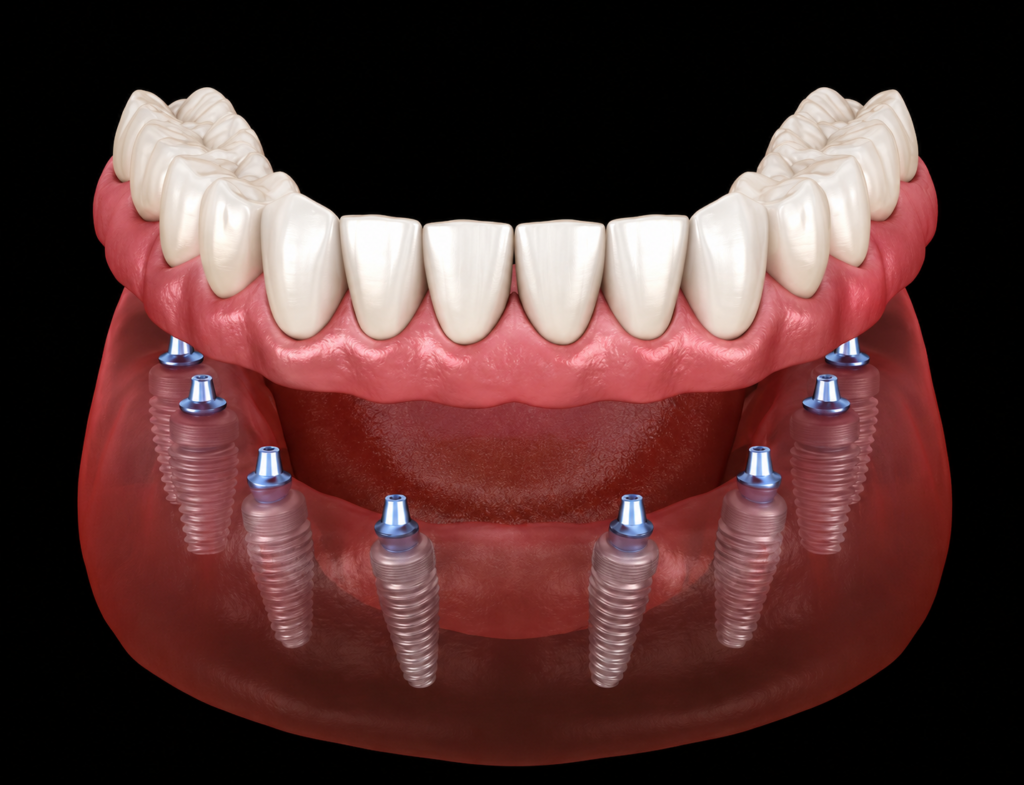
The All-on-8 dental implants use eight implants to support a full fixed rehabilitation of one arch. They may be considered when many or all teeth need to be replaced, but they are not automatically the best solution for every patient.
The choice depends on the amount of available bone, force distribution, occlusion, and the final prosthetic plan. Family Dental Care includes All-on-8 among the implant solutions dedicated to full-arch rehabilitation.
What Does All-on-8 Mean?
The All-on-8 concept is relatively straightforward: eight implants are placed in planned positions along the arch. These implants work together to support a full fixed prosthesis.
This does not mean replacing each individual tooth with an implant. The goal is to create multiple support points and properly distribute the forces of the future restoration.
However, the possibility of using eight implants depends on the patient’s anatomical and clinical conditions. For this reason, the number of implants is determined only after a complete evaluation.
Why Use Eight Implants?
Increasing the number of implants can create more support points for the prosthesis. However, this advantage must be evaluated in the context of the entire moA greater number of implants can provide more support points for the prosthesis. However, this advantage must be assessed by considering the entire mouth, not simply the number of implants placed.
The dentist must determine:
- where the implants can be placed;
- how much bone is available;
- how they will be distributed along the arch;
- what loads they will have to support;
- how the two arches come together;
- what type of prosthesis will be made.
All-on-8 should therefore be considered a specific clinical solution. It is not simply a version with more implants than All-on-4 or All-on-6.
Who May Be a Candidate for All-on-8?
Patients with complete tooth loss
A completely edentulous person may need a new fixed full-arch rehabilitation. If the amount of available bone and the anatomy allow for the proper distribution of eight implants, the dentist may consider All-on-8.
However, the decision is made only after evaluating the future prosthesis as well. The number of implants must be compatible with the functional outcome to be achieved.
Patients with numerous non-restorable teeth
Still having some natural teeth does not necessarily mean they must be removed. Before planning a full rehabilitation, it is important to assess which teeth can be preserved.
However, when several teeth have a very poor prognosis and can no longer reliably contribute to the function of the arch, it may be necessary to consider a full rehabilitation. In these cases, All-on-8 may be one of the configurations to evaluate.
Patients who require support distributed across the entire arch
In some cases, the prosthetic plan may benefit from several support points distributed in the anterior and posterior areas. The use of eight implants makes it possible to create a broader distribution when anatomical conditions allow it.
However, this does not mean that more implants are always necessary. The configuration must be chosen based on the available bone, the occlusion, and the future prosthesis.
Patients with sufficient bone availability
To place eight implants, adequate implant sites must be present along the arch. For this reason, evaluating the quantity and quality of the bone is a fundamental part of the planning process.
A simple panoramic X-ray can provide initial information, but in complex cases more detailed examinations may be necessary. Only after the diagnostic evaluation is it possible to determine whether eight implants represent an appropriate solution.
Bone Quantity: One of the Decisive Factors
Each implant must be placed in a position that is compatible with the surgical and prosthetic plan. When the available bone is insufficient in certain areas, treatment planning may require a different approach.
In certain cases, a bone regeneration procedure may be considered bone regeneration, while in others a different distribution of the implants may be chosen. The decision depends on the anatomy and the specific needs of the arch.
Family Dental Care incorporates bone evaluation into the planning of complex implant treatments. The goal is to define the treatment based on the patient’s actual conditions.
All-on-4, All-on-6, or All-on-8?
This is one of the most common questions in full-arch treatments.
| Solution | Number of Implants | Principle |
| All-on-4 | 4 | Complete rehabilitation supported by four strategically placed implants |
| All-on-6 | 6 | A greater number of implant support points distributed along the arch |
| All-on-8 | 8 | Support distributed across eight implants when the anatomy and prosthetic plan allow it |
The comparison should therefore not stop at the number of implants. Using eight does not automatically make the treatment better than a rehabilitation carried out with four or six.
The most suitable solution is the one that makes proper use of the available bone and allows for a functional, stable, and easy-to-maintain prosthesis.
The Role of 3D CT Scanning
Before planning a full-arch implant rehabilitation, it is necessary to determine precisely where the implants can be placed. Three-dimensional imaging makes it possible to analyze structures that cannot be evaluated simply by looking inside the mouth.
The elements to be assessed include:
- bone height;
- bone thickness;
- anatomy of the maxilla or mandible;
- location of important anatomical structures;
- possible implant sites;
- implant angulation.
This information allows the team to move from the general idea of placing eight implants to a true implant treatment plan. Diagnostic imaging therefore becomes an essential part of the decision-making process.
The Prosthesis Must Also Be Planned in Advance
A common mistake is to focus first on the implants and only think about the prosthesis later. In reality, implants are placed specifically to support the future prosthetic rehabilitation.
Tooth shape, smile line, function, available space, and the relationship between the two arches must be considered from the outset. This makes it possible to determine where implant support will truly be beneficial.
Prosthetic planning therefore also helps guide the surgical plan. The implants and the final teeth must be part of the same treatment plan.
What If Some Teeth Can Be Saved?
All-on-8 should not be chosen automatically when a patient has numerous dental problems. Before planning a full-arch rehabilitation, it is necessary to evaluate each tooth and understand which teeth can still be preserved.
A tooth with a favorable prognosis can continue to play an important role. Conversely, retaining severely compromised teeth can make it more difficult to create a stable rehabilitation.
The decision must therefore begin with the diagnosis. The goal is not to use a particular technique, but to identify the treatment best suited to the clinical situation.
What Happens During the Planning Process
A complete implant treatment journey can begin even before travel by sending X-rays, photographs, and information about the dental condition. This initial phase helps the team understand the case and identify which tests may be needed.
Once at the clinic, the evaluation may include an examination, radiographic diagnostics, and occlusion analysis. The team can then determine:
- which teeth can be preserved;
- which areas are suitable for implants;
- whether additional procedures are needed;
- which implant configuration to use;
- how to design the future prosthesis.
It is during this phase that it can be determined whether the’All-on-8 is truly indicated. The choice is therefore made based on the complete clinical situation and not only on the number of missing teeth.
All-on-8 Is Not a One-Size-Fits-All Solution
Not all patients need eight implants to restore an entire arch. In some cases, four implants may be sufficient, while in others six may provide a more suitable configuration.
For other patients, however, eight points of support may be indicated based on the anatomy and the prosthetic plan. The choice must always be personalized and based on the diagnosis.
The treatment must be adapted to the patient and the condition of their mouth. The patient should not have to adapt to a predetermined technique.
🦷 Want to Know Whether All-on-8 Is Right for Your Arch?
If you have lost many teeth or are considering a full-arch restoration, the first step is to understand which implant solution may truly be suitable for your case.
📲 WhatsApp / Phone: +355 69 70 433 35
📧 Email: info@familydentalcareal.com
🌐 Website: familydentalcareal.com
📍 Family Dental Care – Tirana, Albania
You can send your X-ray and the available information for an initial assessment. The team can explain in Italian whether the most suitable option is All-on-4, All-on-6, All-on-8, or another implant-supported rehabilitation.